
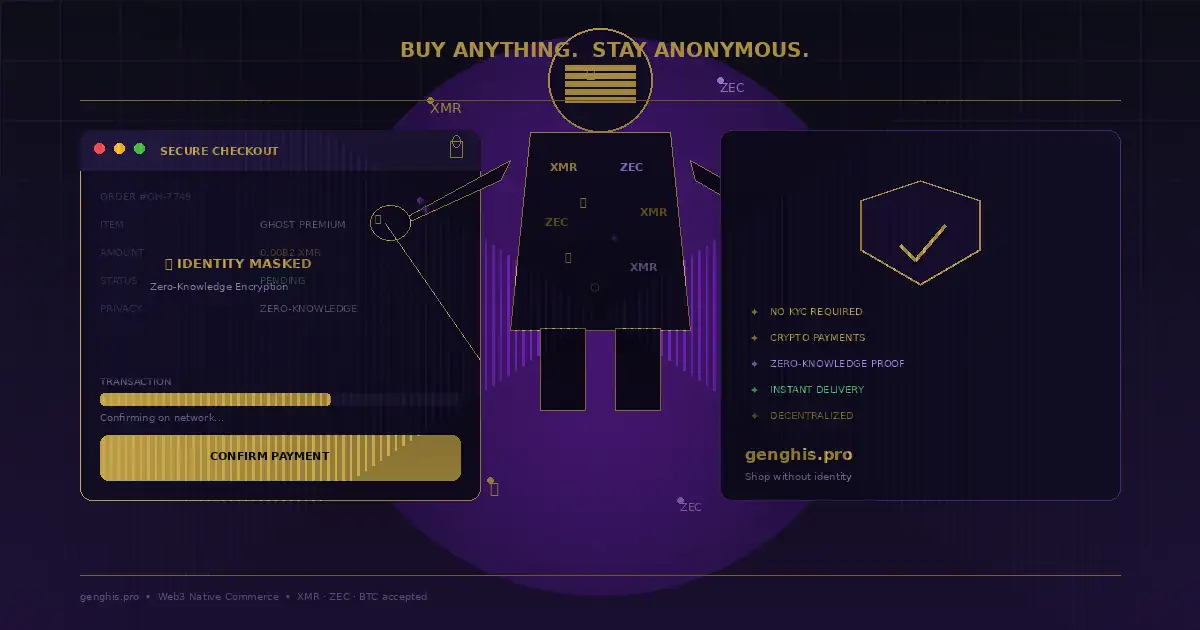
Most people assume that paying with crypto means paying anonymously. It does not.
Every time you buy something online with Bitcoin or Ethereum, you leave a trail of data points: your email address, your IP address, your on-chain transaction history, and often a scanned ID if the platform required KYC. By the time your order is confirmed, three or four companies know who you are, what you bought, and roughly where you live.
Privacy-forward crypto shopping is not about doing anything illegal. It is about the principle that your financial behaviour is your business, not your bank’s, not your exchange’s, and certainly not an ad network’s. In 2026, with data breaches at record highs and surveillance capitalism as the default business model of the internet, anonymous crypto shopping is less a luxury and more a reasonable expectation.
This guide shows you exactly how it works: where privacy leaks, which tools prevent it, which cryptocurrencies are genuinely private, and how platforms like Genghis are built from the ground up to protect your identity at every step.
Why Privacy Matters More Than Ever in Crypto Commerce
The promise of cryptocurrency was financial sovereignty, the ability to transact without a gatekeeper deciding whether you are allowed to. But in practice, most crypto spending still flows through centralised chokepoints that collect, store, and in some cases sell your data.
Consider the typical purchase flow on most crypto-accepting platforms: you create an account with your email address, you verify your identity with a government ID (KYC), you fund your account via an exchange that has already linked your wallet address to your name, and you make a purchase that is permanently recorded on a public blockchain. At no point in this flow is your identity actually private.
The data risks are concrete:
- Data breaches. Your KYC data: name, address, passport scan, stored by exchanges is a high-value target. Ledger’s 2020 breach exposed 270,000 customers’ physical addresses.
- On-chain tracing. Blockchain analytics firms like Chainalysis can trace Bitcoin transactions across hundreds of hops. A public wallet is closer to a public bank statement than to cash.
- Ad targeting. Purchase data sold or leaked to ad networks means your crypto shopping behaviour directly influences what you see on social media.
- Regulatory creep. In multiple jurisdictions, exchanges are now required to report user transaction data above certain thresholds. What is legal today can become reportable tomorrow.
Privacy is not paranoia. It is a reasonable response to an environment where your financial data is a commodity.
Where Your Identity Actually Leaks When You Shop with Crypto
To protect your privacy, you need to understand the specific points where your identity escapes. There are four main leak vectors:
1. The Exchange (KYC at Source)
If you bought your crypto on Coinbase, Binance, Kraken, or any regulated exchange, your wallet address is already linked to your verified identity in their database. Any transaction from that wallet, even to a privacy-preserving platform, can be traced back to you by anyone with access to exchange records.
2. The Merchant Account (Email and IP)
Most e-commerce platforms require an account with an email address. Your email address is a persistent identifier that can be cross-referenced across platforms, used to build a shadow profile, or leaked in a data breach. Your IP address, logged at account creation and at every login, can reveal your approximate location and be matched to other accounts.
3. The Payment Processor (Wallet Logging)
Many crypto payment processors log the sending wallet address as part of the transaction record. This creates a permanent link between your wallet and your purchase, even if the merchant does not explicitly store it.
4. The Blockchain (Public Ledger)
Bitcoin, Ethereum, and most major blockchains are fully transparent. Anyone can see every transaction on the public ledger. Blockchain analytics tools make it trivial to trace fund flows, identify exchange withdrawals, and in many cases de-anonymise wallet holders through transaction graph analysis.
Gift Cards as the Privacy Layer: How It Works
Gift cards are one of the most effective and legal tools for private spending, and they are radically underused by the crypto community.
Here is the mechanism: instead of sending cryptocurrency directly to Amazon, Uber, Netflix, or any other merchant, which would create a traceable on-chain transaction linked to your wallet, you purchase a gift card for that merchant using crypto. The gift card is a bearer instrument: whoever holds the code can use it, with no identity attached.
The privacy architecture looks like this:
- You send crypto from your wallet to the gift card platform (one on-chain transaction).
- The platform delivers a gift card code to your email. No KYC, no ID verification required on platforms like Genghis.
- You redeem the code on Amazon, Netflix, Steam, or any supported merchant, and to them, it looks like any other gift card redemption.
The result: the merchant never sees your crypto wallet. The blockchain never shows a payment to Amazon. Your identity is not attached to the final purchase. The gift card is the privacy break in the chain.
Genghis’s catalog covers over 4,000 brands, including Amazon, Uber, Netflix, Steam, PlayStation, Google Play, Airbnb, and hundreds more, all purchasable with crypto, all delivered instantly as digital codes. The guide to buying Amazon gift cards with crypto walks through the same flow for the most requested brand.
💡 Privacy Tip
Treat gift cards as a privacy buffer between your on-chain activity and real-world purchases. The more you route spending through this layer, the less exposed your primary wallet becomes.
The Most Private Cryptocurrencies for Shopping: XMR, ZEC, DASH
Not all cryptocurrencies are equally private. While Bitcoin and Ethereum transactions are publicly visible on-chain, three tokens are specifically engineered for privacy. All three are accepted on Genghis.
Monero (XMR): The Privacy Standard
Monero is widely considered the gold standard of private cryptocurrency. Unlike Bitcoin, Monero hides the sender, receiver, and transaction amount by default, not as an optional feature, but as the protocol baseline. It uses three technologies simultaneously: ring signatures (to obscure the sender), stealth addresses (to protect the receiver), and RingCT (to hide the amount). Even chain analytics firms have publicly acknowledged that tracing Monero transactions is computationally unfeasible at scale.
For anonymous crypto shopping, XMR is the strongest tool available. Pay with Monero on Genghis and the on-chain record reveals nothing about you, your wallet balance, or what you bought.
Zcash (ZEC): Optional Shielded Transactions
Zcash uses zk-SNARK cryptography to enable fully shielded transactions, where sender, receiver, and amount are all encrypted. Crucially, Zcash offers a choice: transactions can be transparent (like Bitcoin) or shielded. For privacy shopping, always use shielded (“z-to-z”) Zcash transactions. Transparent ZEC transactions offer no meaningful privacy advantage over Bitcoin.
Zcash shielded transactions are mathematically private. The tradeoff is that fewer wallets support the shielded mode natively, so check wallet compatibility before sending.
Dash (DASH): PrivateSend Mixing
Dash offers a feature called PrivateSend, which uses CoinJoin, a coin-mixing protocol that combines multiple transactions to obscure the link between sender and receiver. Dash is not natively private like Monero; PrivateSend is opt-in and requires additional steps in supported wallets. When used correctly, it provides meaningful privacy for everyday spending. Dash is fast, low-fee, and well-supported across the ecosystem.
Dash was built to be spent rather than held. The Dash payment guide covers the detail.
How Genghis Protects Your Privacy by Design
Most platforms that accept crypto are not privacy-native; they adopted crypto payments as an afterthought, layered on top of a traditional e-commerce infrastructure that was built to collect data. Genghis was designed differently from day one.
Here is how privacy is built into the platform architecture:
- No KYC, ever. Genghis does not require identity verification. You do not submit a passport, driving licence, or any government-issued document to make a purchase. Your real name is never part of the transaction.
- No wallet address storage. Crypto payments on Genghis are processed by NOWPayments. Genghis does not log or store your sending wallet address. If you ever need a refund, you provide the wallet address at that point. It is not pre-recorded from your transaction.
- No stored payment credentials. There is no card on file, no saved wallet, no persistent payment profile. Every transaction is standalone.
- 300+ tokens accepted. Including XMR, ZEC, and DASH, the three leading privacy coins, alongside BTC, ETH, SOL, USDT, USDC, and hundreds of altcoins. You spend the token that gives you the level of privacy you want.
- Instant delivery. Gift card codes appear on screen as soon as the payment confirms, and we email you a link to them.
- UK-registered, legally compliant. Genghis Ltd is registered in England and Wales (Company #16315448). The platform respects GDPR, complies with UK financial regulations, and maintains a published Privacy Policy and Refund Policy. Privacy by design, not by obscurity.
✅ Privacy by Design
By removing KYC, minimising data retention, and supporting privacy coins, Genghis aligns its business model with your right to transact without building a permanent dossier on your behaviour.
Step-by-Step: How to Shop Privately on Genghis
Here is the complete flow for a privacy-maximised purchase on Genghis:
- Choose your privacy coin. For maximum privacy: XMR. For shielded transactions: ZEC (shielded mode). For a solid mid-tier option: DASH with PrivateSend.
- Use a non-custodial wallet. Wallets like Cake Wallet (XMR-native), Unstoppable Wallet, or Trust Wallet give you direct control of your keys, no exchange middleman who knows your identity.
- Browse the Genghis catalog. Go to
genghis.pro/catalog. Search for the brand you need: Amazon, Uber, Netflix, Steam, Airbnb, or any of 4,500+ products. - Select denomination and proceed to checkout. Choose the gift card value you need. At checkout, select your privacy coin from the token list.
- Send the transaction from your wallet. Genghis generates a payment address and QR code. Send the exact amount from your wallet. Faster networks confirm sooner than Bitcoin.
- Receive your code instantly. The gift card code is delivered to your email. Redeem it directly on the merchant’s platform. From the merchant’s perspective, it is a standard gift card; your crypto payment is invisible to them.
💡 Extra Privacy Tip
If you want to further decouple your email identity, use a disposable email alias (services like SimpleLogin or Apple Hide My Email) at the Genghis account creation step. The code will be delivered to the alias, which you can forward and then discard.
Need data while you are at it? Genghis also sells eSIM plans for 190+ countries, purchasable with crypto, delivered instantly, no physical SIM, no carrier contract, no name attached to the data plan.
Buy eSIM plans here.
Frequently Asked Questions
Is anonymous crypto shopping legal?
Yes. Using privacy-preserving tools and platforms to protect your financial data is legal in the vast majority of jurisdictions. Buying gift cards with cryptocurrency, including privacy coins, is a legal activity. The right to financial privacy is recognised under data protection law in the UK and EU. Genghis is a UK-registered, fully compliant business.
Do I need to create an account on Genghis?
You need an email address to receive your gift card code. An account allows you to track orders and earn Genghis Points rewards. If you prefer maximum separation, you can use an email alias or a dedicated disposable address. No phone number, no government ID, and no personal details beyond an email are required.
Is Monero accepted on Genghis?
Yes. Genghis accepts Monero (XMR), Zcash (ZEC), and Dash (DASH), alongside over 300 other tokens. XMR is the highest-privacy option available. Select it at checkout and send from a Monero-native wallet like Cake Wallet for end-to-end privacy.
Does Genghis store my wallet address?
No. Genghis does not store your sending wallet address. Payments are processed by NOWPayments, and wallet data is not retained by the platform. In the event of a refund, you provide your wallet address at the time of the request. It is not pre-recorded from your purchase transaction.
What if my gift card code does not work?
Genghis offers refunds within 30 days if a code fails at first redemption, arrives incomplete or never arrives, or our page showed the wrong region. If a code fails at redemption through no fault of your own, write to [email protected] within 30 days of purchase. Refunds are issued in USDT or Genghis Points. Your choice.
Shop Privately. Spend Freely.
Your financial privacy is not a feature request, it is a right. With the right tools, the right cryptocurrencies, and the right platform, you can shop across 4,500+ products online without surrendering your identity to anyone.
Genghis is built precisely for this. No KYC. No wallet logging. No stored payment data. 300+ tokens accepted including XMR, ZEC, and DASH. Instant delivery on every order.
Your crypto. Your rules. Your privacy.
Browse the Genghis Catalog
Start spending your crypto the way it was always meant to work: privately, instantly, and across 4,000+ global brands with no KYC and no wallet tracking.